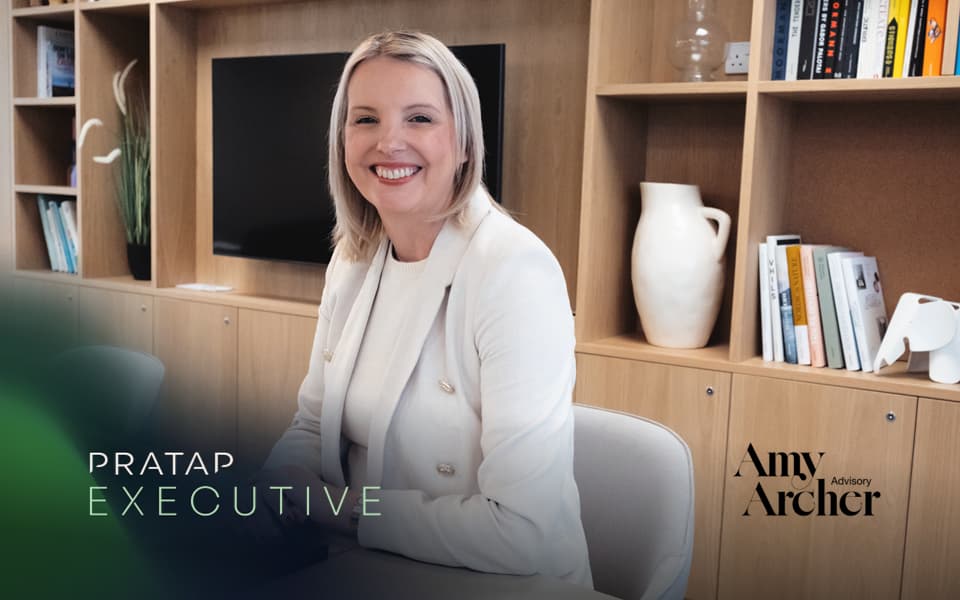
The strategic shift in non-executive appointments
Victoria Robson, who leads the non-executive director practice at Pratap Executive, explores how ambitious businesses are appointing NEDs earlier, focusing on specific capabilities and viewing board appointments as a strategic investment in growth.
The strategic shift in non-executive appointments
Victoria Robson, who leads the non-executive director practice at Pratap Executive, explores how ambitious businesses are appointing NEDs earlier, focusing on specific capabilities and viewing board appointments as a strategic investment in growth.

How are businesses changing the way they appoint non-executive directors?
When I joined Pratap Executive to lead our non-executive director practice, one question came up repeatedly:
“Has the non-executive market changed?”
The answer is unequivocally yes.
Over the past two decades, working both in executive search and in-house with leading private equity and venture capital investors, I have seen a significant shift in how businesses approach non-executive appointments.
The change is not simply in who they appoint, but when they appoint them and what they expect those individuals to contribute. Ambitious businesses are strengthening their boards earlier, recruiting against specific capability gaps and looking for non-executive directors who can combine independent challenge with commercially relevant experience.
The best businesses are no longer treating a non-executive appointment simply as a response to governance requirements. They are viewing it as a strategic investment in the quality of their decision-making and their capacity for growth.
Founder-led businesses are strengthening their boards earlier
One of the most significant changes has been the point at which businesses make their first independent board appointment.
Historically, many founder-led companies considered appointing a non-executive director only after securing investment, reaching a certain scale or encountering more formal governance requirements. Today, ambitious businesses are strengthening their boards much earlier in their development.
This reflects a growing recognition that independent challenge is not a constraint on entrepreneurial leadership. Applied well, it makes a business stronger, more disciplined and more resilient.
SMEs account for 99.8% of the UK business population and employ approximately 16.6 million people. Within this community, scale-ups provide particularly compelling evidence of the value placed on more developed leadership and governance structures.
ScaleUp Institute research found that 59% of scale-ups had a board of directors, with a further 12% planning to establish one. Its analysis also shows that seven in ten scale-ups either have a board or intend to create one.
Governance is increasingly being viewed not as an administrative necessity, but as an enabler of sustainable growth.
Businesses are recruiting for the capability they need next
The criteria used to appoint non-executive directors have also evolved.
The UK Corporate Governance Code has long recognised that an effective board requires an appropriate combination of skills, experience and knowledge. Although the Code formally applies to listed companies, its principles provide a useful benchmark for organisations of every size that want to improve board effectiveness.
The strongest boards are not built by surrounding the table with people whose careers and industry backgrounds look broadly the same. They are assembled around complementary capabilities and different perspectives.
Increasingly, the question is not simply:
“Who understands our sector?”
It is:
“What capability is missing from our board?”
Artificial intelligence, cyber resilience, digital transformation, sustainability, international expansion and operational scale are all creating demand for more specialised board-level expertise. For many growing businesses, the priority is to find someone who has navigated the challenge ahead - not merely someone who already knows the industry.
Sector knowledge still matters, particularly in highly regulated or technically complex markets. However, it is increasingly considered alongside the broader strategic capabilities a business will need for its next stage of growth.
Rachel Hannan runs a non-executive director and chair development programme for BHP Chartered accountants and Translink Corporate Finance, and has over 10 non-executive and Chair appointments under her belt. She comments "Companies ambitious for growth, attracting investment or an exit, are increasingly looking for non-executive directors with ‘situational experience’ i.e. they’ve already led through successful growth, investment or exits themselves, and can bring this insight to bear for the company’s benefit. But an effective non-executive knows the value of previous experience is not in prescribing solutions or a ‘growth playbook’, but asking the right questions, helping the board see around corners, and making better decisions.”
Regional understanding is influencing appointment decisions
The geography of British business has changed as well.
Scale-ups operate across every sector and region of the UK. ScaleUp Institute analysis found that 64% are based outside London and the South East, reinforcing the importance of regional growth ecosystems.
Yorkshire, the North and the Midlands have become significant centres of innovation, advanced manufacturing, technology, professional services and entrepreneurial growth. These regions also possess distinctive investor communities, talent markets and commercial networks.
As a result, businesses are increasingly looking for non-executive directors who combine national or international commercial experience with a genuine understanding of the regional environment in which the organisation operates.
The strongest candidates can bring an outside perspective without losing sight of local context. They understand the nuances of regional markets, but can also connect a business to broader sources of capital, talent, customers and opportunity.
Regional knowledge is no longer simply desirable. In the right circumstances, it can create a genuine commercial advantage.
Board appointments are becoming a strategic investment
The economic contribution made by scale-ups illustrates why the quality of board appointments matters.
The UK’s 34,180 scale-up businesses represent less than 0.6% of the SME population, yet generate approximately half of all SME turnover. Four in ten scale-up leaders also say that better access to non-executive directors and mentors is important to their continued development.
For me, that points clearly to where the market is heading.
Over the next five years, one of the greatest differentiators between businesses that continue to grow and those that plateau will be the quality of their boards.
Technology can be acquired. Capital can be raised. Products can be replicated. Exceptional judgement is much harder to secure.
Rachel Hannan comments that for mid-market companies and SMEs “the best non-executives help the board think better, not think for them - they know when to challenge, when to mentor, and when to get out of the way.”
Businesses that surround themselves with independent thinkers - people who challenge constructively, broaden perspectives and strengthen strategic decision-making - will be better equipped to navigate uncertainty, recognise opportunity and create sustainable value.
The question is therefore no longer simply whether a business should appoint a non-executive director. It is whether it has identified the right moment, the right capability and the right individual to make that appointment count.
At Pratap Executive, we believe exceptional board appointments are about more than filling a vacancy. They are about shaping the future of an organisation.
If you are considering strengthening your board, preparing for investment or exploring how an independent non-executive director could support your ambitions, I would be delighted to start that conversation.

Victoria Robson - Director
07541624011